


Last updated: August 12, 2025.
By Asel Williams, Esq. · Columbia Law School · Licensed immigration attorney
Form I-130A must be filed ONLY if you are sponsoring your spouse for a marriage-based green card.
If you are a United States citizen or a lawful permanent resident (green card holder) sponsoring a family member for immigration, you must file Form I-130 (Petition for Alien Relative) with USCIS.
If the eligible relative is your spouse, you must also file the additional Form I-130A (Supplemental Information for Spouse Beneficiary).
Form I-130A gathers the following personal information about the foreign spouse:
- Address history for the last 5 years
- Employment history for the last 5 years
- Information about parents
- Contact information
If you are sponsoring any other family member (parent, child, or sibling) do not file Form I-130A.
- US citizen or green card holder sponsoring their family member for permanent residency is called “Petitioner“
- Foreign family member being sponsored is called “Beneficiary“
What is Form I-130A?
I-130A is a supplemental form to Form I-130 (Petition for Alien Relative).
Form I-130 is a U.S. immigration form used in family-based immigration petitions.
Form I-130A must be submitted only if Form I-130 is being filed for a spouse.
The foreign spouse applying for permanent residence (“Beneficiary”) fills out and signs Form I-130A.
A completed Form I-130A is then submitted to USCIS with Form I-130A at the same time.
- If submitting Form I-130 by mail, a printed and signed Form I-130A must be mailed together with I-130
- If submitting Form I-130 online, a signed Form I-130A in pdf format must be uploaded under “I-130A” category
Form I-130A – Who Needs to File It?
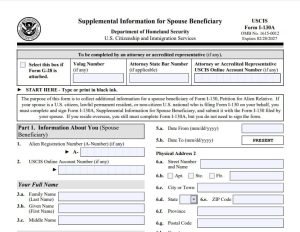

Form I-130A is to be completed by the foreign spouse being sponsored for green card (“Beneficiary”).
Note: if the foreign spouse is located outside the U.S., an unsigned Form I-130A can be submitted.
Can the sponsor fill out Form I-130A?
Yes, the sponsor can fill out Form I-130A.
However, the foreign spouse being sponsored (“Beneficiary”) must review the form prior to submission and confirm that their personal information is provided accurately.
Form I-130A – Who Doesn’t Need to File It?
Only spouses of US citizens and permanent residents applying for green cards must file Form I-130A.
The following applicants do not need to file Form I-130A:
Form I-130A Fees
Because Form I-130A is supplemental to and filed with Form I-130, there are no additional fees.
You only need to pay the fees associated with Form I-130.
Form I-130 filing fee:
- $625 (if filing online), or
- $675 (if filing by mail)
How To Complete Form I-130A
General instructions on completing Form I-130A:
- Form I-130A is completed by the Beneficiary (spouse being sponsored for immigration), not the Petitioner (sponsor)
- You must use the most current edition of Form I-130A that can be downloaded on USCIS website here
- When completing Form I-130A, type or write legibly with black ink.
- It’s important that you fully and accurately answer each question
- Remember, providing false information on any government form may result in your immigration application being denied
- Form I-130A must be signed and dated
- Foreign spouse being sponsored for a green card (“Beneficiary”) must sign and date Form I-130A
- Note: if beneficiary is located outside the US, you can provide a copy of the signed Form I-130A. Also, USCIS will accept an unsigned Form I-130A if the beneficiary is located outside the U.S.
Step-by-step instructions on filling out Form I-130A
Throughout Form I-130A, the immigrant being sponsored for a green card is referred to as “spouse beneficiary.”
If your spouse is a US citizen or permanent resident who is sponsoring you for immigration through Form I-130 (Petition for Alien Relative), you are the “spouse beneficiary.”
Second, if any question on Form I-130A does not apply to you, answer “not applicable,” “N/A,” or “none,” unless otherwise indicated.
Part 1 – Information About You
Part 1 asks about your name, address, and other biographical information.
Question 1 asks for your Alien Registration Number.
Commonly referred to as an “A Number,” this is an eight- or nine-digit number assigned by USCIS.
If you have not received an Alien Registration Number, leave this question blank.
Question 2 asks for your USCIS Online Account Number.
You have this number only if you have created an online USCIS account in the past.
If you do not have a USCIS Online Account Number, leave this question blank.
Questions 4 through 9 asks you about the addresses you have lived at for the past five years.
Provide your physical address history – list all addresses where you have resided (in the U.S. or outside the U.S.)
Start with your current address and work your way backward for five years.
The information includes:
- Street name and number;
- Apartment number;
- City or town;
- State or province;
- Zip or postal code;
- Country; and
- The dates you lived there (from mm/dd/yyyy to mm/dd/yyyy)
It is important to provide USCIS with every address, both in the U.S. and abroad.
If you need additional space to provide the full address history, enter it on the last page of the form (“Part 7. Additional Information”).
If you have lived at the same address for the past five years, you do not have to answer Question 6.
Be sure to answer Questions 8 and 9, which asks about your last address outside the United States.
Questions 10 through 23 asks about your parents, including:
- Family names (last names);
- Given names (first names);
- Middle names;
- Date of birth;
- Gender;
- Place of birth; and
- Country of residence.
If your parents have passed away, you can enter “Deceased” in the “City/Town/Village of Birth” and “Country of residence” fields.
Part 2 – Information About Your Employment
In this section, you must provide your employment history for the last 5 years (in the U.S. or outside the U.S.)
If you have never worked previously, enter “Unemployed”.
Start with your last (or current) employer and work your way backward for five years.
You must provide the following information:
- Names of employer or company;
- Address of the employer, including:
- Street name and number;
- Apartment number;
- City or town;
- State or province;
- Zip or postal code; and
- Country;
- Occupation; and
- Dates of employment (from mm/dd/yyyy to mm/dd/yyyy)
Part 3 – Information About Your Employment Outside the United States
Only complete this section if you have not already provided the information in Part 2 of the form.
If necessary, please enter the following information:
- Names of employer or company;
- Address of the employer, including:
- Street name and number;
- Apartment number;
- City or town;
- State or province;
- Zip or postal code; and
- Country;
- Occupation; and
- Dates of employment (from mm/dd/yyyy to mm/dd/yyyy).
Part 4 – Spouse Beneficiary’s Statement, Contact Information, Certification, and Signature
In Part 4, indicate whether the beneficiary (foreign spouse being sponsored) understands, reads, and/or writes English, or if someone else assisted the beneficiary in completing this form.
In addition, you must also provide the beneficiary’s daytime phone number, a cell phone number, and an email address.
The spouse beneficiary must also sign and date Form I-130A (unless the spouse beneficiary is currently located outside the U.S.)
It’s important to understand that by signing the form you are attesting (swearing) that all answers you gave are correct.
Remember, if any answer is not answered fully and accurately, your immigration application (both I-130 and I-130A) might be delayed and even denied.
Part 5 – Interpreter’s Contact Information, Certification, and Signature
If an interpreter helped you to translate the questions on this form, this person is required to complete the questions in Part 5.
Enter the interpreter’s name, address, contact information, business or organization name (if applicable), and the language used to help the beneficiary translate Form I-130A.
The interpreter is also required to sign and date the form.
Part 6 – Contact Information, Declaration, and Signature of Person Preparing the Form if other than the Spouse Beneficiary
If someone other than the beneficiary helped completing Form I-130A, the preparer’s information must be listed in this section (for example, attorney, petitioner, etc.)
If you were assisted with completing your Form I-130A, this person is required to provide their name, address, contact information, a statement attesting to any accredited representation.
The person who assisted you in preparing the form is also required to sign and date the form.
Part 7 – Additional Information
Use Part 7 if you need additional space in answering questions on this form.
If you use this space, or if you need to attach additional paper to complete an answer, make sure you type or print your full name and Alien Registration Number on the top of every page to assure these pages remain in your file should they become separated.
Form I-130A Checklist
You do not need to submit any supporting documents with Form I-130A, however, make sure to include Form I-130 supporting documents such as:
- Copy of your marriage certificate;
- Evidence that you or your spouse terminated any prior marriages (if applicable);
- Documentation showing joint ownership of the property;
- A lease showing joint tenancy of a common residence (meaning you and your spouse live at the same address);
- Documentation showing that you and your spouse have combined your financial resources;
- Birth certificates of children born to you and your spouse together;
- Affidavits are sworn to or affirmed by their parties having personal knowledge of the marital relationship – with each affidavit containing:
- The full names and address of the person making the affidavit;
- Date and place of birth of the person making the affidavit; and
- Complete information and details explaining how the person acquired their knowledge of your marriage; and
- Any other relevant documentation to establish that there is an ongoing marital union.
Form I-130A Processing Time
Because Form I-130A is a supplemental form and filed at the same time as Form I-130, the processing time is the same – about 7 to 13 months.
Form I-130 Processing Time
| Form type | Application center | Processing time |
| U.S. citizen filing for a spouse, parent, or child under 21 | Nebraska Service Center | 12.5 Months to 16 Months |
| Potomac Service Center | 7 Months to 9 Months | |
| Texas Service Center | 5 Months to 7 Months | |
| Vermont Service Center | 17.5 Months to 22.5 Months | |
| Permanent resident filing for a spouse or child under 21 | California Service Center | 8.5 Months to 11 Months |
| Nebraska Service Center | 20.5 Months to 26.5 Months | |
| Potomac Service Center | 1 Week to 7 Months | |
| Texas Service Center | 5 Months to 7 Months | |
| Vermont Service Center | 17 Months to 22.5 Months | |
| U.S. citizen filing for an unmarried son or daughter over 21 | California Service Center | 56.5 Months to 73.5 Months |
| Nebraska Service Center | 12.5 Months to 16 Months | |
| Potomac Service Center | 7 Months to 9 Months | |
| Texas Service Center | 5 Months to 7 Months | |
| Vermont Service Center | 58.5 Months to 76 Months | |
| Permanent resident filing for an unmarried son or daughter over 21 | California Service Center | 53.5 Months to 69.5 Months |
| Nebraska Service Center | 20.5 Months to 26.5 Months | |
| Potomac Service Center | 1 Week to 7 Months | |
| Texas Service Center | 5 Months to 7 Months | |
| Vermont Service Center | 56.5 Months to 73.5 Months | |
| U.S. citizen filing for a married son or daughter over 21 | California Service Center | 92.5 Months to 120 Months |
| Nebraska Service Center | 12.5 Months to 16 Months | |
| Potomac Service Center | 7 Months to 9 Months | |
| Texas Service Center | 5 Months to 7 Months | |
| Vermont Service Center | 88 Months to 114 Months | |
| U.S. citizen filing for a brother or sister | California Service Center | 104.5 Months to 136 Months |
| Nebraska Service Center | 12.5 Months to 16 Months | |
| Potomac Service Center | 7 Months to 9 Months | |
| Texas Service Center | 5 Months to 7 Months | |
| Vermont Service Center | 99 Months to 129 Months |
You can track the status of your I-130 application through the Case Status Tracking Tool on the USCIS website.
Remember: USCIS approval of an I-130 and I-130A application is only the first step in the process.
If your spouse is already in the U S., he or she might be eligible to file Form I-485 (Adjustment of Status) at the same time or after Form I-130 is filed. Learn more: What is Concurrent Filing?
If your spouse is currently living abroad, he or she must file Form DS-260 (Immigrant Visa and Alien Registration Application) to obtain a visa to immigrate to the United States after Form I-130 is approved.
What Happens if You Do Not File Form I-130A?
If you do not file Form I-130A at the same time you file your I-130 application, you will receive a Request for Evidence (RFE) from USCIS.
You must submit a completed Form I-130A within the specified deadline. Follow the instructions provided in the RFE notice.
Failure to submit Form I-130A in a timely manner might lead to denial of your Form I-130.
Form I-130A FAQs (Frequently Asked Questions)
What is the I-130A form used for?
Form I-130A is used to gather additional information about a foreign spouse being sponsored for permanent residency (“Beneficiary”). Form I-130A must be filed only if a US citizen or permanent resident is sponsoring their spouse. If you are sponsoring parent, child, or sibling, filing Form I-130A is not required.
Who fills I-130A?
A foreign spouse applying for green card through marriage to a US citizen or a green card holder must fill out, sign and date Form I-130A. Form I-130A gathers information about the immigrant spouse (not sponsor).
How long does it take for an I-130A to be approved?
It typically takes about 12-13 months for Form I-130A to be approved. Forms I-130 and I-130A are reviewed and approved together and have the same processing time.
How much is I-130A filing fee?
There is no filing fee to submit Form I-130A. However, you must pay the Form I-130 filing fee:
- $625 (if filing online), or
- $675 (if filing by mail)
Do I need to file I-130 and I-130A together?
Yes, you must file Forms I-130 and I-130A together. If for any reason, you didn’t file Form I-130A with the initial I-130 application, you have 2 options:
- Upload a signed Form I-130A to your online I-130 USCIS application (if filed online);
- Mail a signed Form I-130A to the USCIS Service Center currently processing your Form I-130 (service center can be found in the lower left corner of Form I-130 receipt notice); or
- Submit a signed Form I-130A as response to the Request for Evidence (RFE) issued by USCIS.
Can form I-130A be submitted online?
Yes, Form I-130A can be submitted online. How to submit Form I-130A online:
- Fill out Form I-130A in pdf form
- Beneficiary (foreign spouse) signs and dates the form
- Upload a completed Form I-130A to the sponsor’s online USCIS I-130 application under the “I-130A” tab